
Wednesday, March 16, 2011

Tuesday, March 15, 2011
What Is a Nuclear Meltdown?
A partial meltdown of nuclear fuel rods has occurred in two, or perhaps three, nuclear reactors at the Fukushima Daiichi power plant in Japan. What does that mean exactly?
"A meltdown is when the uranium dioxide fuel melts. The melting temperature of uranium dioxide is 5,189 degrees Fahrenheit (2,865 degrees Celsius)," said Martin Bertadono, a nuclear engineer at Purdue University.
Under normal circumstances, the uranium dioxide fuel rods are maintained at a temperature below their melting point. Heat emitted by the rods gets carried away by the water that surrounds it, which is constantly being pumped through the nuclear core housing the rods. But if the water doesn't get pumped through quickly enough, it heats up too much and starts boiling and evaporates.
"As the water boils, the level of water in the reactor decreases. If the level decreases below the top of the fuel, [the fuel] starts heating up. If this goes on long enough, about an hour, the uranium begins to melt," Bertadono told LiveScience.
"If the water is allowed to boil off completely the whole reactor could melt down," he said.
By flooding the failed nuclear reactors with seawater, technicians at the Fukushima plant seem to be averting a full meltdown, but a partial meltdown has already occurred.
What happens when there's a partial meltdown? "When the fuel melts, the [nuclear] fission products can be released from the fuel into the reactor pressure vessel, and then into the containment if the coolant leaks from the reactor vessel," said Taiwo Temipote, a nuclear scientist at Argonne National Laboratory. The containment is designed to hold in the radioactive material.
"A meltdown is when the uranium dioxide fuel melts. The melting temperature of uranium dioxide is 5,189 degrees Fahrenheit (2,865 degrees Celsius)," said Martin Bertadono, a nuclear engineer at Purdue University.
Under normal circumstances, the uranium dioxide fuel rods are maintained at a temperature below their melting point. Heat emitted by the rods gets carried away by the water that surrounds it, which is constantly being pumped through the nuclear core housing the rods. But if the water doesn't get pumped through quickly enough, it heats up too much and starts boiling and evaporates.
"As the water boils, the level of water in the reactor decreases. If the level decreases below the top of the fuel, [the fuel] starts heating up. If this goes on long enough, about an hour, the uranium begins to melt," Bertadono told LiveScience.
"If the water is allowed to boil off completely the whole reactor could melt down," he said.
By flooding the failed nuclear reactors with seawater, technicians at the Fukushima plant seem to be averting a full meltdown, but a partial meltdown has already occurred.
What happens when there's a partial meltdown? "When the fuel melts, the [nuclear] fission products can be released from the fuel into the reactor pressure vessel, and then into the containment if the coolant leaks from the reactor vessel," said Taiwo Temipote, a nuclear scientist at Argonne National Laboratory. The containment is designed to hold in the radioactive material.
[ By Jeanna Bryer, LiveScience Managing Editor, and Natalie Wolchover, Life's Little Mysteries Staff Writer,
LiveScience.com | LiveScience.com – Tue, Mar 15, 2011 9:24 AM SGT ]
LiveScience.com | LiveScience.com – Tue, Mar 15, 2011 9:24 AM SGT ]
Singapore faces minimal exposure from nuclear radiation
 It was reported that the recent explosion at the Fukushima nuclear plant had caused the radiation level to rise, sparking fears of it spreading to other Asian countries. (Photo: AFP).
 Should there be a nuclear meltdown in Japan, the radiation will take years to reach Singapore and the impact should be minimal, said an expert on energy studies.
Dr Hooman Peimani told The New Paper that if the release of radiation is phenomenal and if the natural means of transportation of radiation, such as wind and water, are strong enough to carry the radiation, then it is possible that radiation could reach Singapore in the future.
But he added that “the radiation strength would be insignificant to cause any damage by the time it reaches us.”
Dr Peimani heads the Energy Security Division at the National University of Singapore’s Energy Studies Institute. Last August, he presented a paper on the viability of underground nuclear reactors in Singapore at the Nuclear Power conference.
Will the food imported from Japan be safe for consumption?
“Yes. Today, there is no indication of exposure of any food in Japan to any volume of radiation beyond the acceptable level,” said Dr Peimani.
“However, if there is any food produced in the proximity of the nuclear reactor and if indeed there is a significant amount of radiation released and food is exposed, it is possible that food produced in that region be contaminated.
“And in this case, the food should not be consumed.”
For example, if there is a chance that fish reared in a farm near a leaking nuclear power plant will be contaminated, the contamination will be passed on to the person who eats it, causing health problems like cancer or complications in pregnancy.
But Dr Peimani said Japan’s health authorities would examine any food from the region which could be exposed to determine if it is safe for consumption.
“The Agri-Food and Veterinary Authority of Singapore would also be stopping such products from reaching us. Food should not be much of a concern and I will not hesitate to eat it,” he said.
An AVA spokesman said products from Japan are being tested for radiation and the it would also monitor Japanese produce –- including fruits, vegetables, meat and seafood -– based on its source and potential risk of contamination.
“Samples will be taken for radiation testing and fresh produce will have priority,” said the spokesman.
On April 26, 1986, the No.4 reactor at the Chernobyl nuclear plant in Ukraine exploded, causing the worst nuclear disaster in history.
The explosion killed 30 people on the spot, released more than eight tons of highly radioactive material, contaminated 60,000 square km of land, and caused more than 3.2 million people to be affected by radiation.
The catastrophe also left a legacy of contamination in the western part of Belarus and Russia and swathes of forest remain affected even two decades after the collapse of the Soviet Union.
[extracted from Yahoo news By Faris – March 15th, 2011]
Friday, March 11, 2011

Thursday, March 10, 2011
The Fed's goal, if it starts buying bonds again, would be to drive interest rates down further from their already low levels and spark borrowing and spending. Lower rates could also eventually drive investors into riskier assets like stocks or into currencies in countries with more attractive interest rates.
Wednesday, March 9, 2011
Last village standing evokes Singapore's rural past
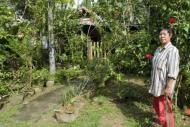 Landlady Sng Mui Hong, 57, poses for a photograph outside her Kampong Lorong Buangkok …
A typical house at a village known as Kampong Lorong Buangkok in Singapore is pictured …
Quietly tucked away in a corner surrounded by high-rise apartments and rows of bungalows is a rustic village where the old Singapore still survives.
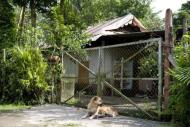 Dogs and cats run freely and chickens cluck noisily as children play around colourful, zinc-roofed houses made of wood and cement, undisturbed by the din of cars zipping by on an expressway just a few metres away.
 Welcome to Kampong Lorong Buangkok, the last surviving village on the Singapore mainland.
Its days are numbered but until development forces residents to move, the village gives visitors a glimpse of what life was like in the 1950s before Singapore became one of Asia's most modern and wealthiest cities.
Occupying a land area the size of three football fields in the northeastern suburbs, the kampong ("village" in the Malay language) has 28 houses scattered haphazardly with a total of about 50 residents.
With unpaved streets, large backyard gardens, grassy patches and occasional banana plants, the cluster is an anachronism in a city-state crammed with office towers, high-rise apartment blocks and shopping malls.
For residents, the village provides relief at the end of each working day, a quiet oasis where neighbours still know each other intimately, quite unlike the anonymity of city living.
"I have a deep attachment to my neighbours," said Sng Mui Hong, a 57-year-old spinster who rents out houses in the village for Sg$6.50 to Sg$30 ($5 to $23) a month.
Most of Singapore's five million residents live in government-built apartment buildings and private condominiums.
"After all they grew up with me, and some of the grandmothers and grandfathers here have watched me grow up," said Sng, who currently lives with a nephew and niece, three dogs and several pet birds.
Her family moved into the plot of land in 1956, when Singapore was still under British colonial rule. Electricity and running water came into the village in 1962, a period when the country was in political transition.
Singapore, a largely ethnic Chinese island, became part of the Malaysian Federation in 1963 but was expelled two years later as Kuala Lumpur pursued policies favourable to the Malay majority.
In modern-day Kampong Lorong Buangkok, racial harmony comes naturally for the Chinese and Malay families whose houses are about five metres (16.5 feet) apart.
"They are like my own parents because we are from the same village. So I don't care if they are Malay or Chinese," Sng said of her older neighbours.
And while the village is by Singapore standards far from supermarkets, schools and bus and train stops, residents rarely mind as there are perks to village life that cannot be found elsewhere.
Some even own cars, a luxury in Singapore.
Makeup artist Jamil Kamsah, who has lived in Kampong Lorong Buangkok since 1967, enjoys the amicable nature of the village folk.
"People here are very friendly, motherly and polite, and it is easy for me to make friends with them," the 55-year-old said. "I don't scold animals and I talk to plants."
In his free time, Jamil tends to his garden and touches up the exterior of his house, welcoming visitors with a ready smile.
In land-scarce Singapore, where many older buildings and residential areas have been converted to more modern housing or commercial use, Kampong Lorong Buangkok faces an uncertain future.
Sng hopes the village can be preserved to educate future generations about the past and show them how their forefathers lived.
"Not everybody started off wealthy, many grandfathers built their lives from scratch," she said
Some city schools take their young students on excursion trips to Kampong Lorong Buangkok to learn about village life.
"Some children mistook the chickens for birds," Kamsah recalled.
The village's days are numbered, and the residents know it.
Singapore's land-use planning agency, the Urban Redevelopment Authority (URA), said there are plans to redevelop Kampong Lorong Buangkok, but gave no time frame.
"The kampong at Lorong Buangkok and its surrounding land is planned to be comprehensively developed to provide future housing and other neighbourhood facilities supported by a road network," said a URA spokesperson.
Sng, however, does not feel sad even if her village has to go one day.
"Nothing lasts forever," she shrugged.
[ By Simin Wang | AFP News – Wed, Mar 9, 2011 1:07 AM SGT ]
Subscribe to:
Posts (Atom)