Monday, June 6, 2011

How did PAP government miss all the signs?


[ extracted from Yahoo.com -By Andrew Loh | SingaporeScene – Sun, Jun 5, 2011 ]
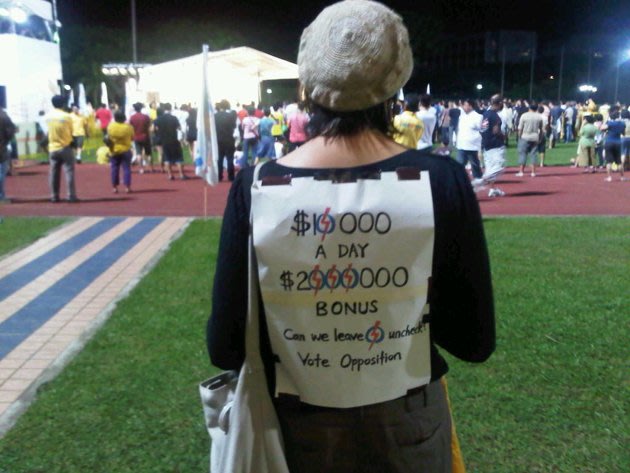
How did the gov't miss all the signs on the ground? (Yahoo! photo/ Fann Sim)(Yahoo! photo/ Fann Sim)


On 28 May, at a dinner to thank People's Action Party (PAP) volunteers, Prime Minister Lee Hsien Loong defended its grassroots leaders and activists from accusations of not having provided proper feedback to the party.

Critics said this shielded party leaders from being cognizant of the unhappiness on the ground surrounding various issues.

However, PM Lee said the fault could lie on party leaders themselves. The Straits Times reported the PM as having said:

"Unfortunately, we may not have picked up and interpreted it correctly, and acted on it the way we should have done, but it's not for lack of trying on the part of the activists."

To pinpoint the communication failure at the party grassroots channels alone would be simplistic and inaccurate. It is not just how feedback from the grassroots were "interpreted" that should be the cause for concern.

The government, and indeed the PAP as well, has many channels to receive and distil feedback -- both within and without the party or government framework. There are the newspapers, the Internet, the Meet-The-People sessions, the much-touted REACH portal, even radio shows and public forums.

The question therefore is: How did the government miss all the signs and was apparently deaf to the alarm bells?


Crux of the matter

One popular reason believed by its detractors, and not without justification, is that government leaders had become arrogant, perhaps believing in their own superior wisdom and dismissing criticisms and genuine feedback as "noise", as one minister put it during the Tin Pei Ling saga.


Having many feedback channels is useless if, at the end of the day, these are not taken seriously.

Thus, it is not about the channels per se or even the processes and procedures in place. It is about the mindsets which government leaders adopt towards criticisms and queries. This really is the crux of the matter. Indeed, the grassroots are not to blame, ultimately.


Ministers, who are themselves MPs in their constituencies, conduct Meet-the-People sessions, too, and interview residents face-to-face. They also speak at public forums.

New Minister of State, Amy Khor, has been and still is in charge of the REACH feedback portal. Ministers too are aware of what is reported in the newspapers and said on the Internet.

So really there is no excuse for not having "interpreted" the sentiment "correctly". After all, even Brigadier-General Tan Chuan Jin, new Minister of State, said he had been aware of the "frustrations, angst" even when he was being considered for candidacy by the People's Action Party for the May elections. "Obviously you hear it from friends, family, so that was something I was very conscious of," he said on Channel NewsAsia.


The problem could lie squarely on the mindsets and attitudes of those at the very top. Consider how government ministers have stoutly, and at times arrogantly, defended their policies when perceived flaws were brought to their attention. 


Sometimes, those who highlight these flaws are scolded and dismissed as "irresponsible", or "daft" and ascribed many other not-so-kind terms.


Obvious issues

There needs to be a change in attitude towards criticism. Ministers must realise that gone are the days when they could hide behind a wall of silence, protected by a compliant media which continuously sing their praises while the masses outside cry out for relief.

Yet, some problems in the last few years were so significant that even if no one brought it to the ministers' attention, he should have known about them anyway.

Consider the sentiment surrounding the housing issue. Many had been expressing unhappiness that prices of public flats were getting beyond their reach. Yet, the minister in charge repeatedly stood his ground and vehemently defended his policies, instead of perhaps taking the feedback seriously and looking into whether there was any truth to them. One newspaper even gave the minister a weekly column to explain why his policies were right even as prices continued to escalate.

The paper would have done better if it had used the print space to highlight to the minister what were wrong with his policies instead.

Another example is the tented homeless communities spread out across public parks in Singapore in 2009 and 2010. How could the Minister for Community Development, Youth and Sports be apparently ignorant of these?

The point here is not about who gives feedback, or the channels available. It is, I would argue, not even about how feedback is "interpreted".


It is ultimately about whether ministers accept that criticisms are important, despite who is making them, and whether it is willing to see and acknowledge that one cannot be right all the time.


It is heartening to know that PM Lee has now embarked on a "reform agenda", as some have put it, and that his new Deputy Prime Minister, Mr Tharman Shanmugaratnam, has set the tone by promising to listen to feedback.

One hopes that his attitude will be an example to his MPs and that they will shed that armour of arrogance once and for all -- the holier-than-thou mindset which drew a most stunning backlash during the recent elections.

[ Andrew is the co-founder of socio-political website The Online Citizen and helmed it for more than four years until June 2011. He also writes frequently on issues which are close to his heart.]


.

Amazing Shocking 360ยบ Flip Throw Goal of High School Student

Floods worse this time around (Singapore)


Basement of Tanglin Mall flooded (courtesy of @onglette)Basement of Tanglin Mall flooded (courtesy of @onglette)


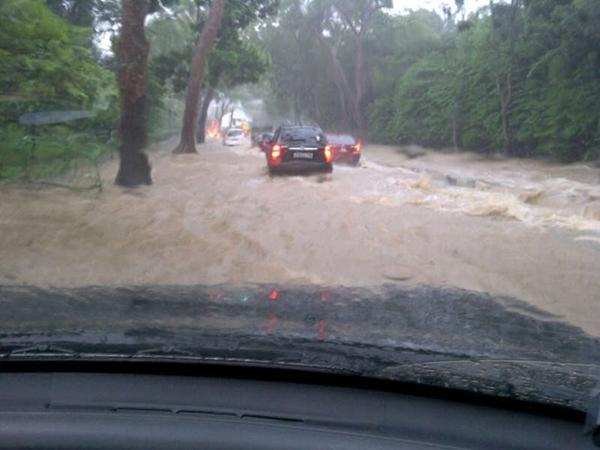
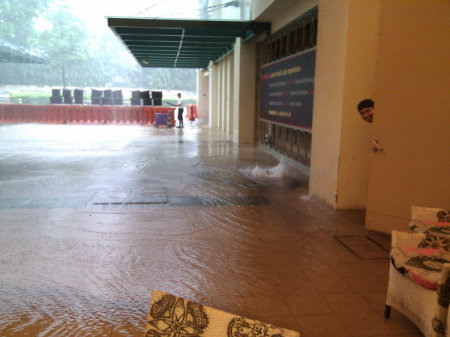
Several retail malls along Orchard Road said the flash floods that took place on Sunday morning was worse this time around than last June.

Tanglin Mall was among the hardest hit with several shops having to close temporarily after flood water from Level One , which was at road level, started pouring in.

Within minutes, water fell like a mini-waterfall onto Basement One. Several businesses -- a supermarket, food court and various shops -- were submerged in ankle-deep water and had to close. There was also widespread chaos after the basement carparks were also affected.

"The shop was flooded to about ankle-level and everyone was running around. The car park was flooded (and) cars were stuck. So everyone was frustrated (and) confused," said Family-Com salesperson Dominic Ngiam, as reported on Channel NewsAsia.

Even the St Regis Residences carpark and Forum Shopping Mall were badly affected by the flash floods.

In June 2010, similar floods along Orchard Road cost businesses hundreds of thousands of dollars.

But this time, employees said the floods were worse.

The Little Gym instructor PJ Lucero said on CNA, "The last time it happened, it was actually more mild. We were still able to open the facility for the day. Today (Sunday), of course, everything got submerged, that's why we had to close down.

"In fact, after the first time it happened, we had sandbags ready. We did use those sandbags today (but) it didn't work. The water just went through it".

Chen Jiahui, store manager of Spinelli Coffee Company along Forum Shopping Mall, added, "This is the second time (it flooded). It's really bad, so I hope that the management are doing something about it".

National water agency PUB said the severity of the flood at Tanglin Mall was something it had not seen in the last 25 years.

It said rainfall was more intense than that of June last year, when various parts of Orchard Road were flooded. About 65mm of rainfall was recorded within 30 mins on Sunday morning, compared to 100mm within two hours on June 16, 2010.

Later in the day, at a press conference which was also attended by Minister for the Environment and Water Resources, Vivian Balakrishnan, PUB explained that the flash floods on Sunday morning were caused by two bouts of heavy rainfall.

It said the first bout of rainfall started slightly past 6am, and second downpour, which was more intense, occurred at about 10.30am.

Speaking after inspecting the flood areas at Tanglin Mall, Dr Balakrishnan said, "Personally, I think our weather has changed. I'm actually psychologically prepared for it to get worse."

"You're dealing with nature, and you're dealing with the weather; you have to be prepared that there is a limit to human engineering and what we can deliver, " he added.

"But having said that, let us make sure we have done the best we can and within those limits, then cope with whatever else that nature throws at us."

In a Sunday post on his blog entitled "Focus of floods: 5 Key questions", the Minister also wrote "We are dealing with Nature, and Man needs to be humble when addressing the challenges that Nature poses".

He also admitted that "sometimes despite our best efforts, we cannot win" when dealing with flood issues but he promised that "we will be open and transparent. We will share as much data in real time as possible so that solutions and precautions can be devised for the immediate and long term."

PUB chief executive Khoo Teng Chye, meanwhile, said he is studying some possible solutions to prevent future occurrences.

"These include, possibly, building a big retention pond near where we can then trap some of the peak flows," Mr Khoo said.

"The other alternative is to really create a diversion canal from where this pond is to the Singapore River. But given Singapore's built-up situation, these are very, very expensive schemes."

Eng Neo Avenue flooded (courtesy of @Nadya_HutaGalng)

The heavy downpour early on Sunday also triggered flash floods across several parts of the island. 


Senett Estate, Potong Pasir, MacPherson, Toa Payoh and Bukit Timah were also partially submerged by floods. 

Two lanes along Bukit Timah Road near Cuscaden and Hillcrest Road were completely impassable to traffic at one stage. So too was the Kranji Expressway (KJE) at the slip road towards Woodlands.


Micro-blogging platform Twitter also lit up with hundreds of tweets, shortly after the flash floods (#sgfloods) hit.


Tanglin Mall flooding (courtesy of @onglette) 
Tanglin Mall flooding (courtesy of @onglette)

Ex-model and VJ Nadya Hutagalung (@Nadya_HutaGalng) tweeted, "Eng Neo avenue flooded!"

Another Twitter user Akmal Hadi (@Athrun988) tweeted, "Singapore is gonna be another Venice at the year end monsoon season if the government's not gonna do anything about it soon."

Another user, Jacqui T tweeted, "First world nation with third world drainage system. Wonderful." 

Charlotte Ong (@onglette) also posted a series of pictures of Tanglin Mall flooding and tweeted, "Check out the waterfall in the shopping centre" and "First level flood pouring down to basement." 


.

Service On Demand (SOD) system; SOD - RAP5000

SOD - RAP5000
(Recover Air Platform - 5000m)

  • Last known "lost" air platform location prior to lost link
  • Automatic program RAP5000 to last position
  • Launch RAP5000
  • Turn on the telemetry to link with Ground Station as well as the "lost" platform
  • Perform rebroadcast function
  • Very fast forward to last position
  • Estimate probable "lost" platform position based on last position, velocity, direction, time till now
  • Project new position and move RAP5000 to new location with consideration of more time needed to reach there
  • Establish link and update "lost" platform with new set of commands
  • Recover RAP5000


.

Saturday, June 4, 2011

Power-One Launches 300W Micro-Inverter and DC/DC Power Optimizer

[extracted from Yahoo.com - Press Release Source: Power-One, Inc. On Thursday 5 May 2011, 1:57 SGT]

SOLAREXPO 2011, VERONA, Italy, May 4, 2011 (GLOBE NEWSWIRE) -- 


Power-One, Inc., a leading provider of renewable energy and energy-efficient power conversion and power management solutions, today announced the launch of its new 300W micro-inverter as well as its DC/DC power optimizer.


With the AURORA MICRO-0.3 inverter, Power-One introduces an alternative to the traditional string inverters the company is well-known for. By linking a micro-inverter to each module, the output of every single panel can be individually controlled and optimized. The second product, the AURORA OPTI-0.3 power optimizer, is also linked to one module and helps maximize the energy output.

"We offer something new to Power-One customers with these two products," said Paolo Casini, Vice President, Product Marketing at Power-One. "Both micro-inverters and power optimizers were designed to help our customers make the most out of installations which have to cope with difficult conditions like partial or temporary shading or significant panel mismatching. Moreover, the MICRO-0.3 is the perfect choice for customers who want to adjust the size of their applications easily."

Micro-inverters like the AURORA MICRO-0.3 offer customers attractive benefits. By equipping each module with its own micro-inverter, each panel benefits from a separate MPPT, creating the optimum power curve for individual panel conditions. This does not only minimize efficiency losses in challenging conditions, but also allows for controlling every module individually, ease of plant expansion without the hassle of string re-sizing or panel matching.

Additional features of the device include efficiency ratings of up to 95.5 percent, a rugged outdoor enclosure and HF isolation, allowing it to fit any application requiring the grounding of either one of the input terminations. The micro-inverter is electrolyte-free to further increase the product lifetime and long term reliability and can be easily installed due to a proprietary wireless communication hub and grid interface included in the package. Up to ten micro-inverters can be connected in a string.

Power optimizers like the AURORA OPTI-0.3 perfectly complement all Power-One AURORA inverters as they optimize the energy harvested from each module in an array. Usually, solar panels are joined together in a serial pattern. If the functionality of one panel is impaired, the energy being produced from the entire installation is reduced accordingly. 

This effect can be significantly lowered by using power optimizers. The AURORA OPTI-0.3 uses DC-to-DC technology to maximize the energy produced by each module within a string as it optimizes the voltage or current for any given weather conditions.

Moreover, the device helps to minimize loss caused by partial or temporary shading and mitigates PV panel mismatch and to acquire single panel data radio transmitted to a communication hub which is part of the package. This helps installers to create the largest installations possible and increases the return on investment (ROI).

The AURORA OPTI-0.3 offers efficiency rates of up to 99.5 percent, a single panel Maximum Power Point Tracker (MPPT) and a temperature hardened construction.


About Power-One

Power-One is the world's second largest designer and manufacturer of photovoltaic inverters. Its renewable energy products enable the industry's highest yielding conversion of power from both solar arrays and wind farms for use by utilities and homes.

Power-One has a 40 year history as the leader in high efficiency and high density power supply products for a variety of industries including renewable energy, data storage and networking, industrial and network power systems.

The company is headquartered in Camarillo, CA and has global sales offices, manufacturing, and R&D operations in Asia, Europe, and the Americas. Power-One is traded on NASDAQ under the ticker symbol PWER. For more information about the Company, please visit www.Power-One.com.


.

Facebook Scams - You Need To Know About

The 9 Most Common Hacks and Attacks


Given Facebook’s fame, it was only a matter of time before con-artists brought their scams onto the network. Facebook today is infested with dozens of different scams, with increasing reports of users falling victim to foul play. If you’re an avid facebook user, here are 9 common scams that you should look out for, and avoid when they inevitably come your way.


1. Clickjacking

Facebook Scams
[Source: Cheerleaders Gone Wild Clickjacking Tempts Facebook Users] Ever seen applications asking you to paste certain chunks of technical (and illegible) code in your browser address bar? This is essentially what clickjacking is; tricking you to paste harmful code in your browser that authorizes foreign access to your Facebook, baiting your curiosity with “Find out who is stalking you!” claims.


2. Fake Friend Requests

Facebook Scams
Ever get friend requests from strangers? That might be because programmed bots were created to expand a scammer's social network for personal gain. You might think it’s harmless to accept their request, but what you are unaware of is that they might be just looking to send you spam or viruses. We know it’s hard to turn down a friend request from a Megan Fox lookalike, but think about it, are you really that lucky?


3. Phishing

Facebook Scams
Phishing simply means an attempt to steal your important personal details (credit card info, passwords) by posing as an authorized or trustworthy site. Facebook has had several of such scams, including some tricky ones that resemble a facebook portal asking you to re-login. The best way to spot phishing sites is to look out for unusual-looking URLs in the address bar.


4. Malicious Pages, Groups & Events

Facebook Scams
Many scam pages exist solely to extract and collect personal information from you. Such pages and groups often try to trick you into inviting your friends to join them or participate in their quizzes (sometimes booby-trapped with phishing schemes) by offering you phony gifts and rewards. Some of these pages may be pose as authentic companies like Microsoft or Apple in order to gain your trust.


5. Fake “Team Facebook” Emails

Facebook Scams
The real Team Facebook always sends messages telling you they will never ask for personal information such as passwords, and they mean it. If you ever get an email or message from “Team Facebook” asking you for passwords, you can be sure they are looking to steal your personal information.


6. Worms & Viruses

Facebook Scams
For a content-rich network like Facebook, there are plenty of opportunities to lay mines for worms and other computer viruses. One such example is the koobface worm in 2008, which posed as links to Adobe Flash Player updates and were circulated to disastrous consequences. Although Koobface worms have mostly been stamped out, there are still cases of infection so watch out for those.


7. Western Union Money Scam

Facebook Scams
An extremely scary scam, this one poses as your friend, sending you a request to urgently transfer cash to him via Western Union (most commonly) or through other wiring services like PayPal. This is where it works best. How do you turn down a friend in need? You don’t, and your money gets stolen. Be very wary when you are asked for money. Tell your friend to call you personally if he needs it that desperately.


8. Unauthorized Surveys

Facebook Scams
It’s extremely common to take polls and quizzes on Facebook. Everyone does, and it’s not a surprise to see your friend update his status about how he is "Captain America of the Avengers”. It’s fun, but watch out for the kind of quizzes you are taking. Some surveys redirect you outside of Facebook, while others require you to enter personal details such as your contact number before you can view results. Reject these, as most of them are scams looking to get your personal details.


9. Harmful Apps

Facebook Scams
Harmful apps often look like they are the real thing. They disarm you with images and text that make them look authentic and harmless, whereas in reality they just want to trick you into “allowing” the app. Once allowed, the app now has liberty to send fake announcements and messages to your network of friends. Heard of the infamous “Facebook Shutdown” scam? This was how it originated.


[extracted from yahoo.com - by Shaun Zhang ]


.